This morning I woke up bright and early at 5:30 to catch a 7:45 train to Florence! We arrived in the city around 9:15 and decided to check out the line to see The David.
The line wasn't very long, so we decided to wait - little did we know, the line would move very slowly. We finally entered the museum around 11:30 and saw the famous sculpture. It is just so much larger than anyone can expect! Although no cameras were allowed, I was able to snap this blurry one (as proof that I was there).
We also stumbled upon this David replica. It looks much smaller, given that it's located in an open piazza, but other than that it's essentially the same. I'm showing the side view here, since I wasn't able to get that shot of the actual statue.
Now for a little art history...it's nice to see this statue in a space more like where it was intended to be viewed. Here we have the possibility of seeing how Michaelangelo wanted the light to hit the statue.
Afterwards, we were starving so we set off to find a restaurant that Lisa (our art history prof.) had recommended. I ordered pasta for the first time since being in Italy, and decided to try the classic fettuccine alfredo. It was great!
Rumor had it that the San Lorenzo market was the place to go to shop for leather goods. Lisa had given us a place to go, and after asking, we found it. Immediately, the owner, Adriano, asked us how we had heard of him. We said our professor had recommended his store, and he knew right away we were talking about Lisa. Given that she sends all of her students there, he gave us a great discount - 50E off the bag! As you can see, bag shopping was a great success!
We perused the other goods at the market - here's a shot of the crowded street. Of course, we're still in Italy, so there is also a beautiful old church in the background.
Next, on to see some of the sights! First stop was the Duomo. We went inside, but decided against paying 8E to climb to the top of the dome. After seeing the Duomo, we made our way down to the river to check out the Ponte Vecchio (famous walled bridge).
Surprisingly, the entire bridge was lined with jewelry shops! By that time, it was around 3 in the afternoon and we were hot - it was at least 90 degrees out - and tired. We met up with others from our program and set out to find a bar to watch the Germany vs. Argentina game. After wandering around and failing at finding an open bar, we eventually made it to one that was only open for the game. We arrived at half time, only to watch Germany dominate Argentina 4:0.
Tired, we found a place to grab a bite to eat and then went to the grocery store to stock up on cookies for the train. Ready to go home, we went to the train station early and were able to change our tickets and get on the 8:40 train home, instead of the 9:10. All in all, it was great to see Florence, but I'm really glad it was just a day trip. All of the great sights required an admission fees, and those that were staying the night faced a lot of problems with booking hotels/hostels, etc. Going to Florence will definitely help me appreciate Rome. I now see how nice it is to have restaurants and great gelato spread out all over the city. Florence was also much more touristy than Rome, so I was happy to get back to Rome :)
New Cigarette Cartons Your doctor or your pharmacist can help you stop smoking.
Smoking is a highly addictive, do not start.
Gelato (modified) Ok, so I have a confession to make. I did have gelato in Florence. I tried caramel again - it tasted like ice cream. Not to say that this is bad, it definitely wasn't even close to comparing with my favorite Haagen Daz dolce de leche, but it really wasn't the gelato I was looking for. Unsatisfied, I got a cone from McDonalds at the train station. This did the trick. I got my ice cream fill, and now I'm ready to go back to the good ol' gelato in Roma!
Class this morning started at 10, which is a little later than usual. After a semi-laid back breakfast, we left the apartment for our daily stop at Cafe di Marzio in Trestevere. Many of us living in Trestevere go here each morning for a cappuccino and the occasional chocolate, fruit or cream filled croissant. Those that work at the cafe know our usual selections and we often converse in broken Italian and English about the latest World Cup update.
This morning was also special because we had a guest speaker, Amara Lakhous, talk to us about his book, Clash of Civilization Over an Elevator in Piazza Vittorio. For the class Migration, Markets and Minorities, taught by Professor Friedman, we have used this book as a way of attempting to understand the social and economic situations immigrants face when first arriving in Italy. Often, our analysis also explores the concept of Italian identity and how this is a product of Italy's history.
Piazza Vittorio is significant because it is a community that attracts the majority of the immigrants living in Italy. This piazza also houses the market that we visited on Wednesday. Amara Lakous lived in Piazza Vittorio for six years, so he as able to give us some additional insight as to challenges that arise in this area because of its incredible diversity.
Lakhous emigrated from Algiers in the early 1990s due to great political unrest, to include terrorist attacks, in Algeria. Today, he writes novels in both Arabic and Italian, and has earned degrees in philosophy and cultural anthropology, including Ph.D. Clash of Civilization Over an Elevator in Piazza Vittorio was also recently made into a movie.
Although Lakhous seemed to understand much of the English we spoke while phrasing questions, we had an Italian interpret for us so that the questions could be answered clearly and directly. Themes from the novel, such as identity and coming together despite diverse backgrounds, formed much of the basis for our discussion. One interesting question that Lakhous dissected for us was: as an immigrant, is it beneficial to hold onto your past, or forget it completely and move forward with your life? Lakhous' response to this question was particularly perceptive and well supported. He called upon Freudian psychology to discuss the problems people face when holding onto the past. For example, physically they are in Rome, but mentally they are somewhere else. Lakhous used an example which he had encountered on his way to the UW Rome Center from the train station, specifically the scene of an Ethiopian immigrant and her child. The mother was talking to herself in her native language, as if totally wrapped up in past memories. The power of the brain, such that it can keep the mind and body separated was an example of a significant drawback immigrants face when they tightly hold on to their past. Lakhous suggested that perhaps the most effective way of assimilating into a new country was to find a balance between remembering your past and moving forward in a productive way, such as learning the local language. Overall, Lakhous brought very personal and astute observations to our continuing discussion on migration.
After Lakhous' talk we headed back to the apartment for a relaxing lunch composed of our staple Italian foods, namely bread, mozzarella, tomatoes and basil. Most people caught up on blogging or reading and soon we were re-charged and ready for an afternoon of art history.
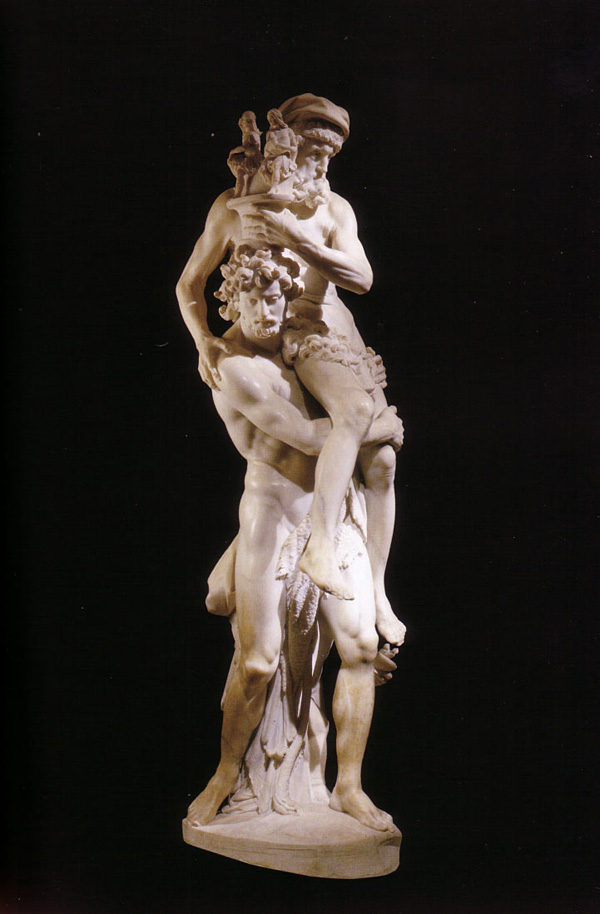
Our art history class and presentations took place at the Villa Borghese. First, we heard an introduction to the Borghese Family by Roman and Emily, and the Roman told us more about the history of the Villa Borghese as well as the major patron and collector of art, Scipione Borghese. I was particularly interested in the fact that Scipione Borghese was a big fan of Bernini and commissioned him to do many works of art. We learned that Bernini liked to combine his originality and artistic eye with poses and styles reckoning back to antiquity. For example, his piece entitled Aeneas, Anchises, and Ascanius (see photo below, left) is based on Michaelangelo's Risen Christ (see photo below, right), although Aeneas is carrying his father instead of the cross.
Inside the Museo di Villa Borghese, we also saw quite a few paintings by Caravaggio, a Boroque style painter. This portrait, David with the head of Goliath, was Roman's favorite Caravaggio piece inside the museum.
After a lot of walking (it took almost an hour to get to Villa Borghese from our apartment!), my apartment mates and I settled in to cook dinner and relax before meeting up with the group again to celebrate Molly's 20th birthday.
For Molly's birthday, we went out as a group to a great little gelato place called Gelateria del Teatro. They have a lot of original, alternative flavors, such as sage and raspberry.
Here's a picture of Molly enjoying her birthday gelatto!
We chose to celebrate a day early because the majority of the group is going to Florence for the weekend! Hopefully some of the great sights and adventures will make it into the blog!
Check out Google Earth! It now includes Ancient Rome!
Now, on to other things I did in Rome today...
I browsed a leather shop, where the bags, belts, etc. are designed by the daughter and made by her father, right there in the store.
The leather workshop.
Finished products!
Also, I've started a collection of empty cigarette cartons sporting very explicit warnings against smoking. This is something my Disease in History professor did in France throughout the years. According to him, the only thing that effectively decreases cigarette sales is raising the tax on them. I've seen near 5 between today and yesterday.
Let me start by saying that anyone traveling, especially to Italy, needs to carry Tide to Go (stain remover) with them at all times. I am constantly dripping, splashing or spilling yummy, oily thing on myself. Tide to the rescue!!
This morning we went to Piazza Vitorrio, which has been the central element in my migration class. It's located very close to the train station, and a very large population of immigrants. We spent our time in the market and got tons of fruits and vegetable, such as cauliflower, tomatoes, peaches, apples, cucumbers, potatoes, carrots, peppers, etc. Yesterday we got some free spices at the Rome Center so we made curry, and plan to do it again.
Lots of rice at the Market in Piazzo Vittorio.
After the market we bought our train tickets to Florence! Kristin, Melissa and I will take the fast train and will have 12 hours to spend in Florence. The majority of the people in my program will be going as well, but there's a wide variety of people taking the fast or slow train, and spending the night or only staying for a day.
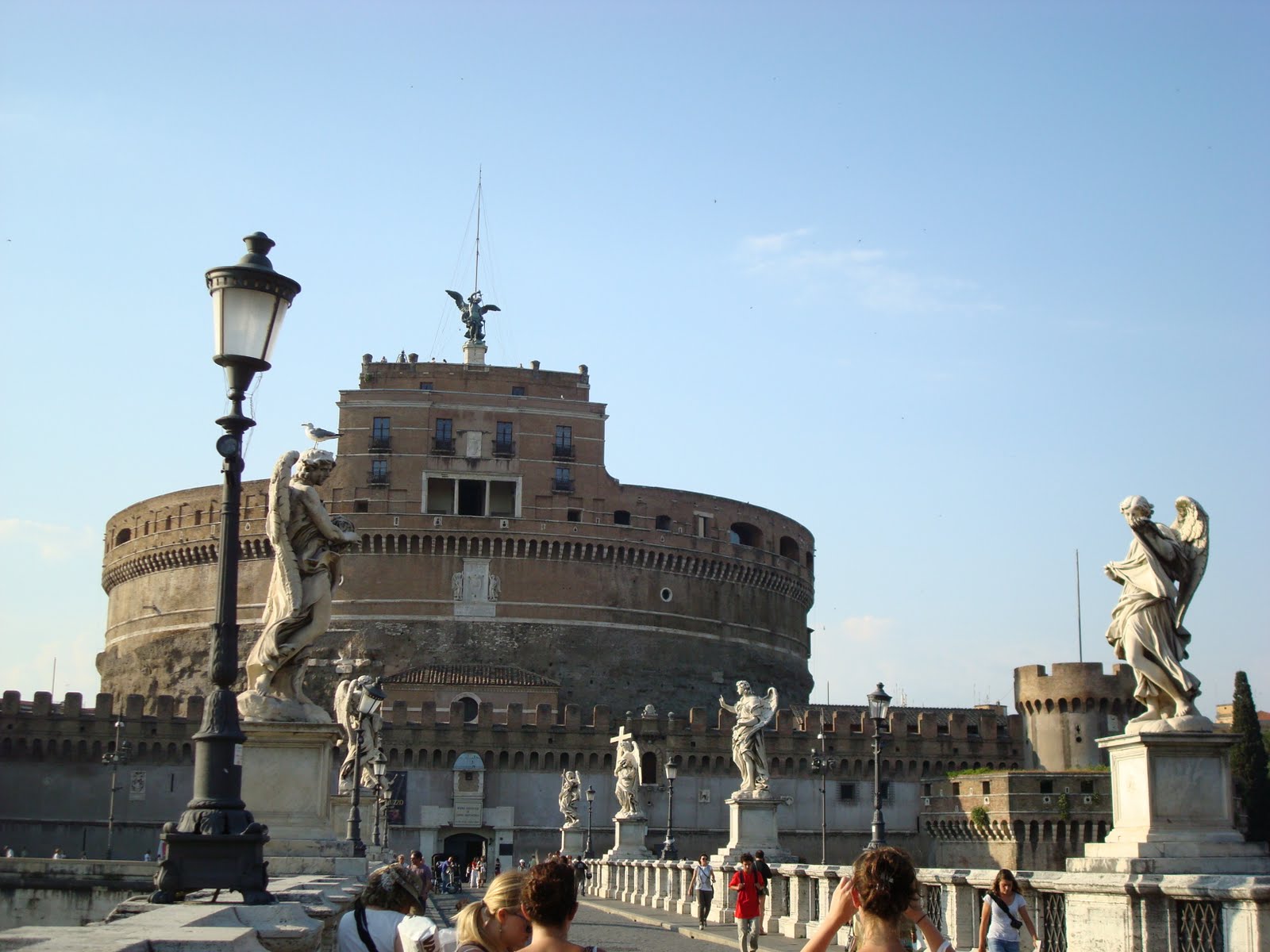
This afternoon, we had two sessions of art history. We first went to the Capitoline Hill where we spent a couple of hours in the Musei Capitolini. My most favorite part of the museum was was going down underneath the courtyard into the ancient tabularium - the place where ancient records were housed. From here, we had a great view of the Roman Forum. Next we visited Castel Sant Angelo which is an ancient castle and prison. Interestingly, this was originally commissioned by Emporer Hadrian as a mausoleum (tomb) for Hadrian and his family.
A Roman classic - Romulus and Remus suckling the she-wolf.
View of the Roman Forum from the tabularium.
Castel Sant Angelo, an old prison located on the Tiber River.
A gorgeous statue, also known as a seagull perch.
The second century bridge (ponte de angeli) leading to Castel Sant Angelo.
Gelato So a big update on the gelato front! My roommates and I got gelato before class - it was almost 90 degrees out (!) - and then we got it again with our prof. between visiting sites. I only repeated coffee, so I have 4 new flavors to comment on.
Pesca (Peach) - a little disappointing because it wasn't particularly flavorful. There were pieces of real peach in it, which was comforting. I'll probably have to try this one again at a different place.
Yogurt - essentially frozen yogurt. The particular one I tried wasn't incredibly creamy, but it was still very good and refreshing.
Crema Catalana (vanilla caramel) - this wasn't especially flavorful, but I combined it with tufola and coffee, which was a great combination. And, it was definitely better than the previous caramel type I tried.
Tufola (sp?) aka 4 types of chocolate - sooo good! Definitely the best chocolate variety I've tried. It had chunks of fudge and other chocolatey chunks in it. For all of you who know that I'm a fan of chunks in my ice cream, I'm sure you're not surprised that this was a hit.
In ancient times, Trajan’s Column, Market and Forum acted as a central hub, brought to life by the people shopping for everyday food items, visiting the libraries, and attending civic court. Today, despite the fact that the Forum has not survived the test of time, the Market’s space is still utilized and the Column of Trajan stands proudly, in near perfect condition. Regardless of the state of the remaining structures, the sheer size of the space and value of the materials that remain give the modern day viewer a sense of the magnificent complex that celebrated Emperor Trajan and rewarded the Roman people. It is through the grand space, intelligently designed structures, and extravagant remnants of ancient materials that continue to perpetuate the memory of Trajan as an accomplished military man and benevolent emperor.
Only one year after Domitian’s assassination in 97 AD, Nerva adopted Marcus Ulpius Traianus (Trajan) as his son and the heir of the Roman Empire. This decision employed successful political policy, for the Roman Army did not respect Emperor Nerva, as their loyalty still lay with the late Emperor Domitian. On the other hand, Trajan had been a senator and army commander and was currently Governor of Upper Germany. Trajan’s military accomplishments made him a good candidate for he could compensate for Nerva’s inability to lead the Roman Army. After Nerva’s death in 98 AD, Trajan, who was born in Spain, became the first emperor not of Italian descent and also the first of the Five Great Emperors. Each of the Five Great Emperors was known as being moderate, less oppressive rulers who had earned the respect of the Roman people. Additionally, the emperor preceding each of the Five Great Emperors had adopted them, such that the current emperor could choose his successor and hopefully provide continuity of ruling practices for the Roman people.
Trajan, who is said to have excelled at war, expanded the Roman Empire to its greatest boundaries. Inevitably, while pushing the boundaries of the Roman Empire, wars will occur. Given that Trajan had a personal fondness for battle, effort on his part was required to convince the public that such wars were necessary. Therefore, after winning the second war against the Dacians in 106 AD, Trajan commissioned the engineer Apollodurus of Damascus to build a gift for the people of Rome, namely the Market, Column and Forum of Trajan, using materials and spoils from recently conquered Dacia. The Column of Trajan bears the most explicit relation to the Dacian Wars as a detailed account of the wars spirals up the Column’s shaft. Newly accessible resources in what was previously Dacian land, such as rare colored marble, were proudly taken advantage of and displayed in the Forum.
Description
Trajan's Glorious Forum: Drawing
Reconstruction drawing of the Forum of Trajan shows:
(1) the triumphal arch at the entrance
(2) statue of the emperor on horseback
(3) hemicycles
(4) Basilica Ulpia (a law court), (5) two libraries
(6) Trajan's Column, and
(7) his temple.
Passing by the Forum of Augustus, Roman citizens proceeding into Trajan’s Forum would walk under the triumphal arch (1) marking the entrance, and first and foremost would be exposed to the product of Trajan’s successful military conquest against the people of Dacia; this victory was seen in the form of an abundance of marble, colored with veins of purple and gold, lining the square and coating the forty-foot columns. Furthermore, their eyes would immediately be drawn to the grand Equestrian Statue of Trajan (2) set equally between the hemicycle (3) located on the exterior of both long sides of the Forum’s walls. Looking ahead, one would see the area just beyond the far columns darkened by the roof of the Basilica Ulpia (4). On top of the lower roof level, directly above the columns, stood statues of Dacian prisoners, gazing solemly downwards with a look of defeat etched on their faces. Passing through this ancient court of law, and then between the closely spaces East and West Libraries (5), one would have to gaze 140 feet into the sunlit sky searching for the statue at the top, eyes pouring over the long tale of the Dacian Wars circling the surface of the intricately detailed Column (6).
The Column of Trajan was constructed by placing twenty-nine blocks of Luna marble on top of each other, and then carving the exterior. The 600 foot long frieze marching up and around the column at a slight angle civilly depicted Roman soldiers, battle techniques and most importantly Trajan, conquering the people of Dacia. Unlike the harsh reality of war, grotesque images were omitted from this frieze. This is thought to be because the people of Dacia were generally well respected and moreover, merciless depictions would not help Trajan gain public support for his wars. Interestingly, depending on the time period, the statue situated on top of the Column would change. The eagle originally placed on top of the Column at the time of its completion was replaced by a statue of Trajan after his death in 117 AD. In 1587 the top of the Column lay vacant, as the statue has disappeared during the Middle Ages, so Pope Sixtus V commissioned a statue of St. Peter to take residence at the top of the Column.
From inside the Forum, looking to the east, it is possible that Romans were able to see the Market of Trajan nestled into the Quirinal Hill over the Forum’s walls, but there is no doubt that they had an exceptional view of the Markets and Forum from the ballastere of the Column. Climbing to the top of the spiral staircase within the Column was described as “a ‘sudden surprise’… as the visitor's abrupt emergence from the narrow, dark staircase into the dazzling sunlight, where [she or] he stood, blinded for a moment, surrounded on all sides by open air, released from total restriction to utter freedom (Davies, 2000, pg. 65).” The height of the Column’s lookout is thought to be representative of the height of the Quirinal Hill before the hill was cleared away to prepare for the construction of the Forum. The Temple of Trajan (7), which was not constructed until after Trajan’s death, was built to the north of Trajan’s Column by Emperor Hadrian, who was Trajan’s adopted son.
When used as a marketplace, Trajan’s Market must have been bustling with shoppers buying their daily provisions, such as bread, fruit and olive oil, as well as other people on their way to work in the upper stories of the Market. The Market, built six stories into the Quirinal Hill, had space for approximately one hundred and fifty stores or offices. It is suggested that the vendors sold their items from the lower-most level of the Market, as that was easily accessible from the ancient street. Taken together, Trajan’s Column, Forum and Market incorporated practical structures and exquisite resources that constantly reminded the Roman people of their victory over the Dacians.
A contemporary view of Trajan’s Market and Column
Function
The Column
Whether Apollodorus intended this or not, Trajan’s Column is interpreted today to have multiple layers of possible functions. The most obvious purpose of the Column is to illustrate Trajan’s path to victory during the two Dacian Wars. Scholars continue to debate the significance of the continuous story that spirals up the Column. Viewers often complain that they cannot see very far up the Column, or that they lose their place while following the military narrative. From these criticisms stems the idea that perhaps one was not meant to follow the sequence of events until one could no longer make out the figures on the relief, but rather the Column was intended to be viewed from any single location around its base only as far up as the eye can clearly see.
On the other side of the spectrum, Davies presents the argument that it is the act of reading the spiraling story that is important, not the account of the Dacian Wars itself. Moreover, she proposes that one’s movement around the invisible circular track that must be followed to read the twisting narrative forces the viewer into reenacting the ancient funerary ritual of circumambulation, intended to honor and remember the deceased. This claim is further supported by the fact that Trajan and his wife Plotina were buried at the base of the Column for some time, as well as the persistent importance of the circle as an ancient Roman symbol.
After learning the story of the Dacian Wars, people could enter into the Column to climb its internal staircase. The darkened staircase winding its way to the platform near the top of the Column could be used by Romans to look out upon Trajan’s Market and Forum, which were the products of the spoils won during the Roman victory over the Dacians. If the glory of victory alone failed to excite the people about the expansion of the Roman Empire through conquest, surely this was not the case when one looked out over the astounding complex Trajan built for his people.
The Forum
The Forum of Trajan is located right next to the Forum of Augustus and it is no accident that one must pass the Forum of Augustus to find the only entrance to Trajan's Forum. Rather, this was a tool used by Trajan to associate himself with the great emperor Augustus. Additionally, looking underneath the Forum’s exquisitely decorated façade it becomes clear that the floor plan is modeled after an ancient Roman military camp. The decision to use the miliatry camp as a template for the Forum design works to enforce the underlying theme of Trajan's enthusiasm for war, as well as his military successes that set him apart as an accomplished military man.
Floor Plan of Trajan’s Forum
The function of the individual structures within the Forum, such as the Basilica Ulpia and East and West Libraries, are more straightforward – they were simply built to be used by the people. The Basilica Ulpia was a place where court cases could be heard and senators could save their valuables, and the East and West Libraries housed documents and books that could be stored or read.
The Market
The largest "mall" of its time, the Market of Trajan, provided an indoor shopping experience for the citizens of Rome and was the first of its kind. The incorporation of this building into Trajan’s complex is perhaps the only element commissioned solely for the people. Of course, the one exception to this is that Trajan’s generous gift to the people inevitably makes himself look good.
Goals of the Patron
Trajan's love of war served the Roman Empire well, but it also required him to convince the people of Rome that war was necessary. The first Dacian War occurred from 101-102 AD, and unfinished business resulted in a second war with the Dacians, lasting from 105-106 AD. Given that the expenses of war are great, and the two had been fought in a relatively short amount of time, Trajan built his complex to celebrate the successes of these wars, give much of the spoils back to the people, and most importantly teach the people that although wars are difficult, victory can bring many great rewards. While the Column and Forum of Trajan focus on explaining the narrative of the Dacian wars and displaying war booty, scholars suspect that Trajan was also subtly preparing the people of Rome for his next military campaign – the invasion of the Parthian peoples. If today’s politicians learned anything from Ancient Roman emperors it was that underlying, personal motives tend to be overlooked when they are accompanied by “gifts” for the people.
Conclusion
The Column, Market and Forum of Trajan reflect intelligent, innovative and stunning design by Apollodorus of Damascus and the fact that the Column and Market are still standing today prove the quality of these second century designs. While viewing the Column, the modern person has the privilege of learning the story of the Dacian Wars, as well as the military techniques used to conquer the Dacian people. Unfortunately, people today can no longer climb the staircase up to the platform situated beneath the statue of St. Peter to view the spacious Forum and Market, or circle around the column to decide for oneself whether the act of circling the column deserves more merit than the extensively detailed narrative gradually spiraling up the Column. Although the Forum and Market are one of a kind, the design and war-themed content depicted on Trajan's Column were borrowed to create the Column of Marcus Aurelius, adding weight to the argument that the purpose of the spiraling frieze was not simply to tell a story. To this day, the statement made by Ammianus Marcellinus during ancient times still holds true; the Forum, Market and Column of Trajan, as a whole, was “never again to be imitated by mortal men (Packer, pg. 34).” For this reason, those passing by Trajan’s Column, Market and Forum continue to be amazed by the empty space representing the size of the Forum, the extraordinary, lasting architecture of Market and Column, and the sheer height and precise detail of the Column. Overall, these elements persuade the modern viewer, just as they must have during ancient times, to remember the greatness of Trajan’s military victory against the Dacians and his philanthropic character that compelled him to use the spoils of war to better the life of the Roman people and teach them of the glories of war.
Personal Interests
While researching Trajan’s Complex as a whole, as well as the Column, Market and Forum individually, I was captivated by the debate over the intended purpose of the spiraling frieze encircling Trajan’s Column. Although I think the possibilities put forth by both Davies and Packer are well supported, and definitely plausible, the originality and strength of Davies’ argument came to me as a complete surprise. Her argument was so compelling that I could not wait to get to Rome to see for myself whether my personal interpretation of the Column depended on whether I was circling or standing in place while admiring the frieze. To my dismay, people today are not easily able to go down below the modern street level to stand or circle at the base of the Column. Regardless, I appreciated the variety of perspectives and interpretations of the Column. I felt that the different angles opened up the discussion on the subject and worked to help those studying this complex explore it deeper and begin to think about new interpretations of the Column and its function.
Bibliography
Davies, Penelope J.E. “The Dynamics of Form.” Death and the Emperor: Roman Funerary Monuments from Augustus to Marcus Aurelius. Cambridge University Press, 2000.
Davies, Penelope J.E. “The Politics of Perpetuation: Trajan's Column and the Art of Commemoration.” American Journal of Archaeology, Vol. 101, No. 1 (Jan., 1997), pp. 41-65.
Lancaster, Lynne C. "Building Trajan's Column" American Journal of Archaeology. 1999, 419-39.
Happy St. Peter and Paul Day everyone! Not knowing what this holiday was about, I looked it up on Wikipedia. Here's what I found:
The Roman Martyrology assigns 29 June as the feast day of both Peter and Paul, without thereby declaring that to be the day of their deaths. St. Augustine of Hippo says in his Sermon 295: "One day is assigned for the celebration of the martyrdom of the two apostles. But those two were one. Although their martyrdom occurred on different days, they were one."
...and from an early date it has been said that they were martyred at Rome at the command of the Emperor Nero, and buried there. As a Roman citizen, Paul would probably have been beheaded with a sword. It is said of Peter that he was crucified head downward.
Really, to me, this day means that no markets or stores are open. Luckily, my favorite cafe was open :)
All in all, today was basically a catch-up day. We were up early, as the plumber came at 8 to deal with the bathroom, which was a successful visit! Gelato Crema (cream) - like other flavors, this was a little disappointing. I'm not really sure what I was expecting (whipped cream?), but it definitely wasn't what I was expecting. I kept on tasting a hint of an underlying flavor, maybe egg, hopefully orange, that I really wasn't fond of.
Cioccolato (chocolate) - really good!This was a very dark (as opposed to milk) type of chocolate gelatto that was great. But, I have to admit (as both of my followers know) nothing is more satisfying than a piece of dark chocolate.
Notes and Notable Differences Pastries - another one of Rome's surprisingly cheap eats. Pastries, at my favorite cafe, are only .80E and this is not your simple, standard treat you'd expect for that price in the US. The .80E pastry variety includes chocolate filled pastries, cream or fruit filled croissants, plain croissants and other delicious breakfast pastries. Yum! Church Bells - Every 15 minutes, churches sound their bells. Traditionally, I believe it's one bell for quarter after, two for half after the hour and three for three quarters after the hour, and then the time of day (seven, etc.) on the hour. The church nearest to us does not follow this patter, and I'm not sure exactly what it's pattern is. I do known that it tolls every 15 minutes, though. What I find most intriguing about these bells is that sometimes you hear them and sometimes you don't. This, of course, correlates to your distance to a church during these times, but also depends on the wind, the noise level in the street/area and your attentiveness to outside noises.
This afternoon, for art history, we went to the Vatican. After a little waiting in line and a little sweet talking the Italians, we got in.
Raphael - my new favorite Renaissance artist.
Raphael - again.
A pretty outdoor courtyard, with very expressive statues.
A pretty ceiling...I can't remember the details.
Rafael's self portrait (he's the guy looking out, engaging the reader); a wall fresco in a Vatican apartment.
After class at the Vatican we watched a movie for another class. It was called the Orchestra of Piazza Vittorio. Piazza Vittorio is the main place that immigrants settle in Rome. In my class on migration, we read a book centered in this Piazza, and have now watched the movie. The movie was a documentary that told the story of people from all over the world, who came together to start an international orchestra - the music was really great! All in all, it was a long, but productive day.
 The line wasn't very long, so we decided to wait - little did we know, the line would move very slowly. We finally entered the museum around 11:30 and saw the famous sculpture. It is just so much larger than anyone can expect! Although no cameras were allowed, I was able to snap this blurry one (as proof that I was there).
 We also stumbled upon this David replica. It looks much smaller, given that it's located in an open piazza, but other than that it's essentially the same. I'm showing the side view here, since I wasn't able to get that shot of the actual statue.
 Rumor had it that the San Lorenzo market was the place to go to shop for leather goods. Lisa had given us a place to go, and after asking, we found it. Immediately, the owner, Adriano, asked us how we had heard of him. We said our professor had recommended his store, and he knew right away we were talking about Lisa. Given that she sends all of her students there, he gave us a great discount - 50E off the bag! As you can see, bag shopping was a great success!
 We perused the other goods at the market - here's a shot of the crowded street. Of course, we're still in Italy, so there is also a beautiful old church in the background.
 Next, on to see some of the sights! First stop was the Duomo. We went inside, but decided against paying 8E to climb to the top of the dome. After seeing the Duomo, we made our way down to the river to check out the Ponte Vecchio (famous walled bridge).
 Your doctor or your pharmacist can help you stop smoking.
 Smoking is a highly addictive, do not start.